
The White-Spotted Pufferfish
The white-spotted pufferfish (Torquigener albomaculosus) is a type of pufferfish that was discovered around the Ryukyu Islands of Japan. Only recently have these fish been connected to a mysterious geometrical structure found on the seabed.
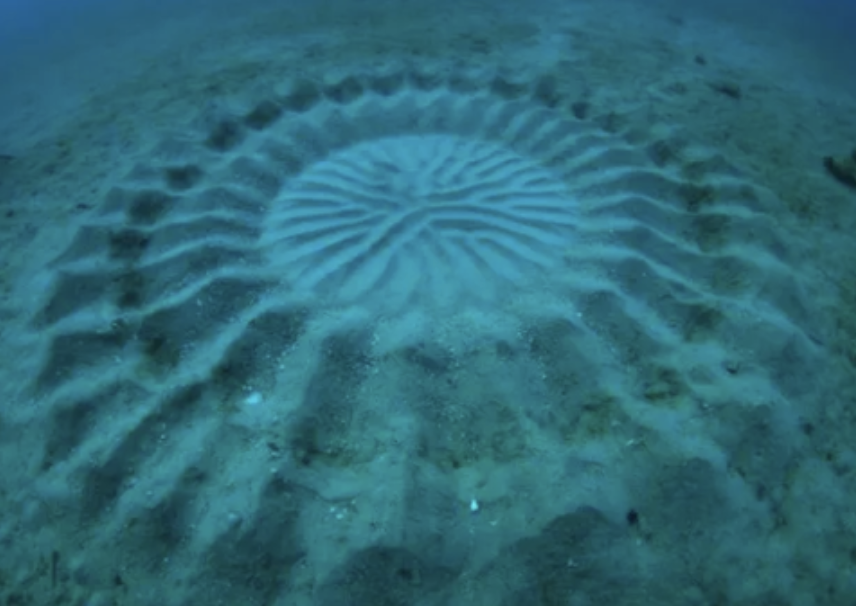
Intricately constructed designs have been visible on Japanese seabeds since 1995, but only recently a white-spotted pufferfish was observed creating one of these. In 2011, a 120mm male pufferfish was seen carrying out the task of building what is referred to as an ocean crop circle.
Crop circles: using art to attract his mate
These underwater crop circles are comparable to the crop circles that have emerged in farming fields, where areas of crops have been flattened to form complex designs with uncertainty around how they were constructed.
Approximately six feet in diameter and at around 80 feet below sea level, ocean crop circles are designed by a male white-spotted pufferfish to attract a female for mating. It is possible that because he lacks colour and vibrancy, he must use his artistic skill to engage the female. The male flaps his fins as he glides across the ocean floor, creating peaks and valleys, leaving behind an ornate pattern in the sediment with a nest in the centre, and he then decorates the edges of his design with seashell and coral fragments.
The purpose of this structure is not only to attract a female mate, but it also functions as a channel to deposit fine sediment and particles in the nest. This process takes around seven to nine days to complete, and if successful, the female will lay her eggs in the nest and the male will guard the eggs for around six days. After the eggs are hatched, the male will return to the area and begin the creative process again, reconstructing a new design for the next reproductive cycle.
Appreciating the artist’s work
Appreciating the beauty of these underwater formations is to appreciate the natural instinct, hard work and intellect of the white-spotted pufferfish. As humans we sometimes struggle to value other species because we struggle to relate to them, however humans and animals have the same life functions; movement, sensitivity, respiration, nutrition, growth, reproduction and excretion. Different species carry out these functions in different ways, but the importance of one of these functions to one species is just as important to another.
The white-spotted pufferfish have captured the attention of humans and have sparked an admiration for their romantic masterpieces in the sea. Humans have a natural desire for romance as we are an inherently affectionate species. Romance offers us a sense of security in overcoming loneliness and a desire for romance can be traced to the instinctive need to procreate. This offers us an explanation for our emotional response to the romantic creativity of this pufferfish.
Should we have to relate to another species in order to appreciate them?
The romantic pursuit of the white-spotted pufferfish helps us to value and identify with them. Just as we can relate to the romance of the pufferfish, we can use our emotional capacity to appreciate other species and the way they carry out the same life functions. Similarly, just as humans have the capability to appreciate the differences among themselves, they can also appreciate the differences among other species.
See YouTube video: https://www.youtube.com/watch?v=hpdlQae5wP8