Consumers’ Role in Improving Aquatic Animal Welfare
Annually, around 100 billion aquatic animals are farmed with a further 2-3 trillion caught in the wild to satiate our growing demand for seafood. By comparison, this is about 35 times more than all farmed land animals. Yet, the welfare of aquatic animals has been historically neglected.
Ample evidence shows that many commonly caught and farmed aquatic animals have the capacity to feel pain and suffer just like their land-based cousins. This has led to a growing movement for aquatic animal welfare, led by the Aquatic Animal Alliance, the first alliance created to advocate for aquatic animal welfare. Modeled after the Open Wing Alliance to end the use of cages in egg-laying hens, we believe urgent action is needed to shift the way we think about aquatic animals and start taking their welfare into consideration.

Net cages along the coast of Norway | FAO Aquaculture photo library | Y. Olsen
Aquatic animals are essential to keeping our marine ecosystems healthy, and are under enormous threats from human activities, such as intensive fish farming and industrial-scale fishing. According to the UN Food and Agriculture Organization, only 6.2% of global fish populations are “underfished.” This means that 93.8% are being fished either at or over the absolute maximum sustainable limit to prevent their populations from crashing.
Meanwhile, global aquaculture production is now the fastest-growing food sector in the world, providing over 50% of the fish that people consume. While aquaculture has improved and continues to improve its impact on the environment, it is still far from being a sustainable sector. For instance, roughly ⅓ to ½ of all wild-caught fish are used as feed for aquaculture. To put this into perspective, one farmed salmon requires roughly 120 anchovies as feed to reach marketable weight. Problems like fish feed inefficiencies, animal welfare concerns and other issues are prompting major institutions to reevaluate their aquaculture development plans going forward (e.g. EU, FAO).
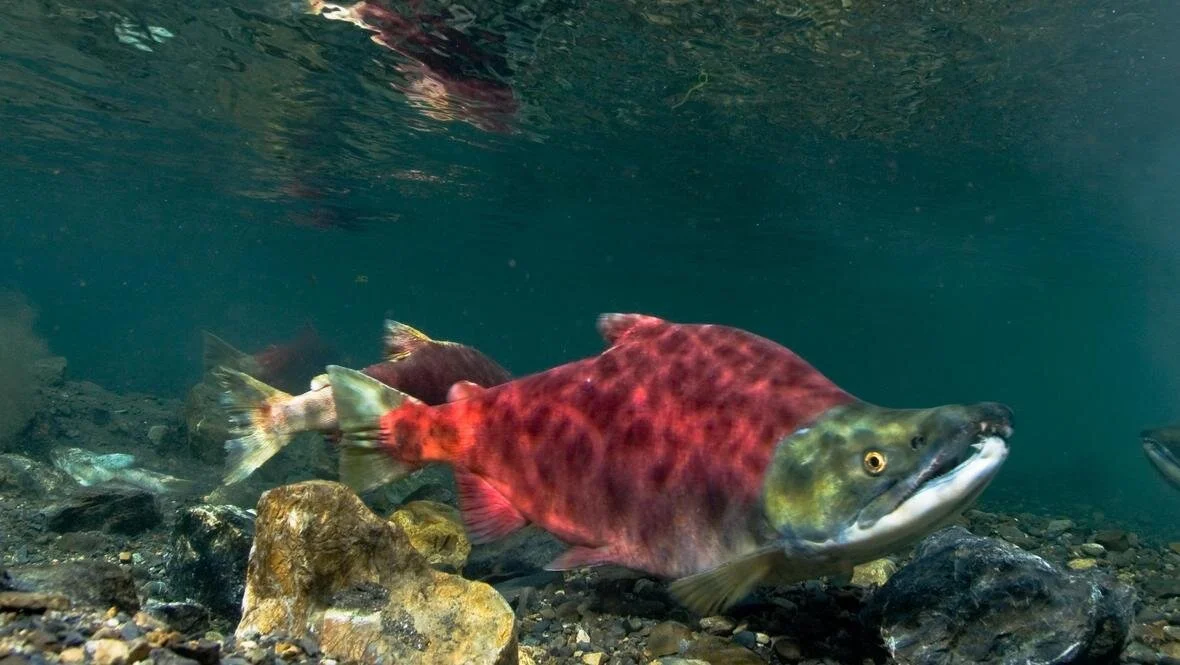
Sockeye Salmon
Solutions exist. First, as consumers we have both a choice and immense purchasing power in our hands. For individuals who are in a position to do so, we absolutely should end or sharply reduce our consumption of aquatic animal products. In order to continue food production under planetary health limits and feed 10 billion people by 2050, the need for a drastic transformation in food systems cannot be stressed enough. Even the biggest seafood businesses realize this: that they are built on a declining resource and therefore face increasingly riskier financial exposure. By ending or substantially reducing our overall consumption, we can give fish populations a chance to recover, local fishing communities - those whose livelihoods depend on fish - a chance to survive, and curb the endless demand that is driving industrial fishing vessels to travel further and further out to sea because coastal fisheries simply do not have enough fish anymore.
Second, a change in our food systems is needed, and can be achieved by ending our consumption of aquatic animals, or at least reducing and changing the type of aquatic animals we consume. Meaning, if we do choose to eat them, we should purchase animals that are less problematic to farm such as bivalve species. Although farming more herbivorous species, such as tilapia and grass carp, could potentially mitigate some of the conservation problems inherent to the farming of carnivorous species, such as salmon, trout and shrimp, these practices are also linked to serious animal welfare, public health, and environmental issues. Changes in consumption patterns can serve as a catalyst for aquaculture producers to shift the types of species they farm, and the number of animals farmed.
Third, and very much tied to the Alliance’s ongoing campaign, is consumer demand for high-welfare certification schemes. Currently, 70% of adults surveyed in Europe are under the false impression that seafood sustainability labels, by default, include the humane treatment of aquatic animals. For this reason, we are working with seafood certification schemes from around the world to ensure that the individuals farmed under those regulations are protected by science-backed welfare standards. By integrating animal welfare as a key component of sustainability, we can see health improvements that result in less stressed animals, better immune systems, less susceptibility to disease and therefore less reliance on antimicrobials, and higher survival rates. Despite the fact that science is still far from understanding how to provide these animals with good welfare under farming conditions, aquaculture certifiers can certainly incorporate the available knowledge to their certification schemes in order to mitigate the myriad of health and welfare problems that these individuals typically endure as a consequence of the farming practices they are subjected to.

Early morning catfish harvest in Noxubee County, Mississippi |FAO Aquaculture photo library | Kevin Hudson
So far, ALI and our alliances have submitted joint public comments to the following certifiers and other decision-makers advocating for the incorporation of meaningful welfare standards or have suggested ways to strengthen existing standards:
GlobalGAP
Marine Stewardship Council (MSC)
Best Aquaculture Practices (BAP)
Aquaculture Stewardship Council (ASC)
Washington Department of Ecology
National Farm Animal Care Council (NFACC)
The Canadian Aquaculture Industry Alliance (CAIA)
Canadian Aquaculture Act
World Benchmarking Alliance (WBA)
Friend of the Sea
US National Oceanic and Atmospheric Administration (NOAA)
Global Animal Partnership (G.A.P.)
To date, three have responded positively: GlobalGAP, Global Animal Partnership and the World Benchmarking Alliance. These have updated their standards based on our comments and in the case of GlobalGAP, even extended their deadlines to welcome additional comments specific to animal welfare. We were particularly pleased that GlobalGAP added an entirely new animal welfare category focused on environmental enrichment -- an intervention that has the potential to be highly effective and economical for enhancing the psychological and behavioral welfare of aquatic animals. Environmental enrichment consists of increasing the complexity of the areas where the animals are kept, adding different objects or modifying the configuration of the space .
We were also very impressed with the 24 species-specific welfare checklists administered by Friend of the Sea, and were able to offer valuable recommendations that can be easily incorporated into these existing documents. We also submitted comments to the Aquaculture Stewardship Council (ASC) and are hopeful that they will take our comments into consideration.
By Saad Salim | Upplash
Much more work remains to be done in this area, as we have identified over 80 certification schemes around the world. Going forward, consumer awareness is essential to exerting more pressure on producers and certifiers in order to build a truly humane and sustainable food production system in the shortest possible term. In the meantime, and as public demand grows, we are confident that more and more certifiers will reassess their standards and adopt our welfare recommendations in order to make progress with reducing the suffering endured by farmed fishes. In the near future, having more certifiers on board will contribute to the entire supply chain’s actors’ commitment to improving welfare standards for aquatic animals, from fish farmers to retailers.
What can you do?
Start seeing aquatic animals as individuals rather than stocks
If you are in a position to do so, replace your consumption of products derived from aquatic animals partially or entirely with nutritious plant-based foods (and vegan seafood)
If you are not in a position to stop eating aquatic animals altogether, reduce your consumption as much a possible and choose species that pose less environmental, public health, and animal welfare problems, such as bivalve molluscs
Share this statement in your social networks to increase public awareness regarding this very important issue
Sign up to our newsletter to learn more about how you can support our work
Signatories:
Aquatic Life Institute
Compassion in World Farming
Fish Welfare Initiative
Fundación Vegetarianos Hoy
Conservative Animal Welfare
Animal Nepal
The Humane League
Equalia
Mercy for Animals
Montreal SPCA
Alianima
Essere Animali
Asociación para el rescate y bienestar de los animales
Protección Animal Ecuador
Sibanye Trust
A Plastic Ocean Foundation
OceanHero.today
Advocating Wild
Change For Animals Foundation
Sinergia Animal
Nurture Imvelo
Humane Society International
Catholic Concern for Animals
Sources:
1. *Fishcount.org.uk (2019). Numbers of Fish Caught from the Wild Each Year. [online] Available at: fishcount.org.uk/fish-count-estimates-2/numbers-of-fish-caught-from-the-wild-each-year (This source’s estimate that between 0.79 and 2.3 trillion fish are caught in the wild each year excludes other types of aquatic animals and illegal, unreported, and unregulated (IUU) fishing. Therefore, we use 2-3 trillion as an estimate for all aquatic animals caught in the wild.)
2. Mood, A. (2010). Worse things happen at sea: the welfare of wild-caught fish. [online] Available at: http://www.fishcount.org.uk/published/standard/fishcountfullrptSR.pdf
3. Mood, A. and Brooke, P. (2012). Estimating the Number of Farmed Fish Killed in Global Aquaculture Each Year.
4. Aquatic Life Institute (2012). Interpreting “Blue Loss” and Measuring the Hidden Animals in Our Food System. [online] Available at: https://ali.fish/blue-loss