Disastrous Salmon Farming Project for Animal Welfare
In 2024, nearly two million salmon will be produced each year on an intensive aquaculture farm in Pas-de-Calais. Accidents in such structures have already caused the death of several hundred thousand fish. Such breeding - and their corollary, an excessively high density of animals - raise important ethical questions.
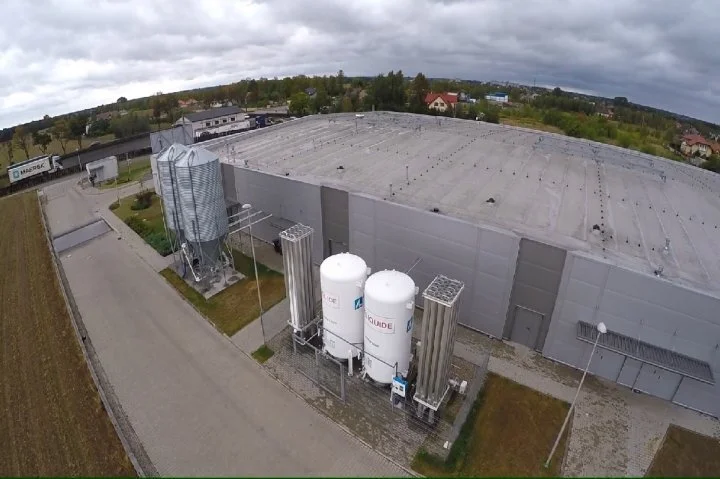
The project was announced with great fanfare on January 20 at the Choose France summit - an event aimed at promoting the country's economic attractiveness to foreign investors. From 2024, ten thousand tons of salmon - nearly two million animals - will leave each year what promises to be the largest land aquaculture farm in Europe: Pure Salmon France, in Boulogne-sur-Mer, in the Pas-de-Calais. An investment of 175 million euros.
Special project: the use of Israeli technology provider AquaMaof , Aquaculture Specialist " in recirculated system" (called RAS , recirculating aquaculture system ). RAS installations, aquaculture equivalents of intensive pig or chicken farms, are closed places in which the production environment is tightly controlled by a computer system. Water, in particular, must be constantly filtered, treated and oxygenated in order to be able to be reinjected without risk into the breeding tanks. Presented as a solution to the pressure of fishing on the oceans, this growing industry raises new problems concerning animal welfare.
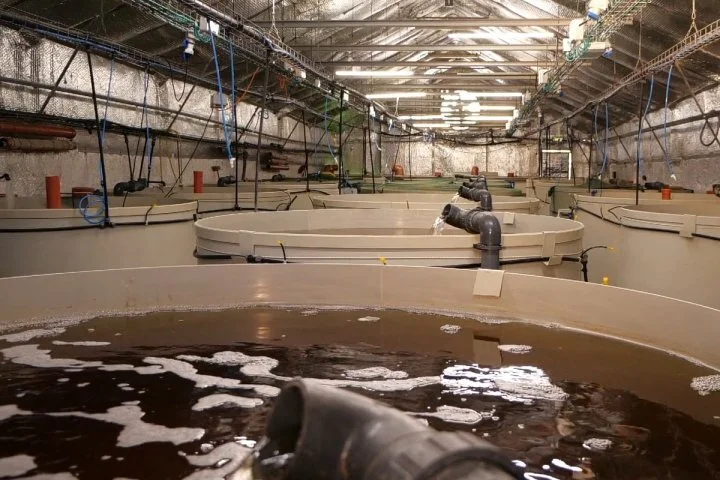
One of the systems set up by AquaMeof, the aquaculture equivalent of intensive livestock farming.
The high level of technicality required by these installations is of particular concern to Susanna Lybæk, zoologist and scientific advisor for the Norwegian animal protection alliance. Asked by Reporterre , she explains: “When the RAS installations work well, they work very well. But when they fail, the results are catastrophic. Technical failure or human error can kill thousands or even millions of animals very quickly. These problems are so new that producers can be taken by surprise and lack the expertise, experience and emergency protocols to resolve situations before it is too late."
There is nothing improbable about such a catastrophic scenario: in February, 227,000 salmon died in a Danish RAS farm owned by Atlantic Sapphire. The cause is a sudden and unexplained increase in nitrogen levels in the water. A 2018 report on the state of Norwegian aquaculture from the Norwegian Veterinary Institute observes that “in recent years, a series of acute mortality events have been observed [in RAS farms ], for which short periods of high concentration of hydrogen sulphide have been suspected to be the causative factor. "By the admission of one industry player, there is a saying that " you have to kill a million fish in the SAR before you know what you are doing”.
Lynne Sneddon, a biologist at the University of Gothenburg in Sweden, shares the same concern. In 2002, she was the first scientist to identify nociceptors that detect painful stimuli in a fish:
Fish form social relationships, including with other species, assess the risks and benefits of a situation, actively engage in pleasurable experiences… They can also be in pain, fear and be in distress. They are sentient beings. It is essential that we view them the same way we view birds and mammals, and protect them equally. These systems must demonstrate that the well-being of the fish is assured before they are allowed to operate at full capacity. "
A precautionary principle that does not seem to be on the agenda. “The high investment costs and the large potential profits have prompted some to speed up the incorporation of technology into their production,” laments Susanna Lybæk. It is risky to leave millions of animals at the mercy of a technology we have little control over. The animals pay the price.
“Insane” population densities
The discomfort does not end there. The investment and operating cost of recirculated terrestrial farms requires particularly high livestock densities to make the system economically viable. “In the cages at sea, the volume is 98% water, 2% fish. This is impossible to follow on land, and the fish will have much less space than at sea” says a report from the Salmon Group, a trade association of Norwegian salmon producers. Culture density is of the utmost importance for fish, however, as it influences several factors essential to animal welfare: water quality, incidence of disease and aggressiveness between congeners.
According to the international NGO for sustainable livestock Compassion in world farming ( CIWF ), the average density in a recirculated system is 80 kg / m 3 , four to five times more than in marine cages. Moreover, this article published in November 2019 on the specialized site Salmon Business reveals that “AquaMaof is testing different densities and survival rates in the [Polish] plant it owns at 50/50 with its partner Pure Salmon […] . During these tests, the density is pushed up to 175 kg / m 3 ."
"These densities of population are insane, indignant the biologist Lynne Sneddon. RAS systems should not exceed 20 kg / m 3 . This is what is done in other forms of aquaculture, and trying to increase that just for profit is unethical to me." Elena Lara, marine biologist and research manager for CIWF , agrees. “We are extremely concerned about the high stocking densities that will likely be required to make these farms profitable. CIWF opposes the use of recirculated systems."
A growing front in the defense of fish
Still neglected a few years ago, including within the animal defense movement, today fish can count on organizations entirely dedicated to the defense of their interests. Aquatic Life Institute ( ALI ) is the most recent example. Created in 2019 at the initiative of William Bench, a French polytechnician now residing in New York, ALI 's mission is to improve the well-being of aquatic animals. The first initiative of ALI was to launch the Aquatic animal alliance , an international coalition grouping to date thirteen associations.
Amandine Sanvisens, French representative of this coalition, did not remain indifferent to the announcement of the Pure Salmon France project: “We immediately requested a meeting with the management, to discuss their vision of animal welfare. We are talking about a giant farm, with a lot of financial means. We believe that Pure Salmon could give itself the means to be exemplary on this subject.” Despite reminders, the request for collaboration remains unanswered to this day. Not to discourage Amandine Sanvisens, used to running long-term campaigns. “Our research team scoured the scientific literature to identify the criteria on which we are requesting commitments very precise. Limits must be set.” Armed with this expertise, the association submitted proposals as part of the public consultation on the Operational Program of the European Maritime and Fisheries Fund ( EMFF ) 2021-2027, the aquatic equivalent of the common agricultural policy. A petition calling for the implementation of specific European regulations for farmed fish is also online. “Remember that in France, there are no specific regulations for aquatic animals concerning well-being. The regulations applied are those of terrestrial animals, which makes no sense!"