
Marine Ecology with Morgan Bennett-Smith
Morgan Smith is an ecologist, focusing on work in the field, conducting a wide range of diving and survey work. He is currently working on three research papers, and getting ready to publish a book with the director of the Red Sea Research Center focusing on photographs he’s taken in the Red Sea over the last two years. In this interview, we discuss aquatic animal sentience, his experience working in marine biology, and his outlook on the disruptions that aquatic animals face today.
Wakes up, looks out the window, goes straight back to bed. #quarantinenaps (Morgan Bennett Smith)
Why did you get into marine science?
My name is Morgan Bennett-Smith, I’m from Penryn, California, a small town situated between the Pacific Ocean and the Sierra Nevada mountains. I grew up splashing around in the tide pools near Monterey, California, and I was always enthralled by the ocean’s biota. I turned my childhood fascination into a career after I moved to Los Angeles, CA, where I majored in biology with an emphasis in marine science at Occidental College.
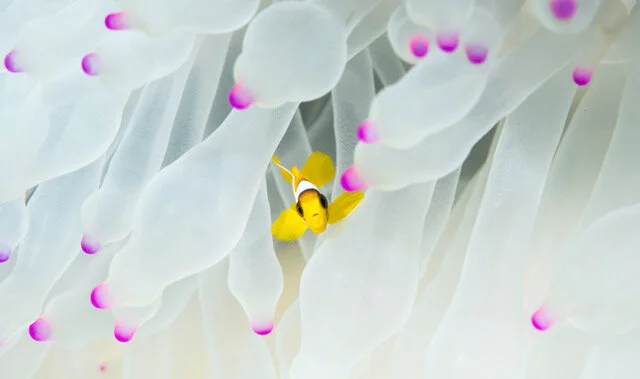
I’d like to personally thank this tiny clownfish for being extremely photogenic, and apologize for the ways humans are impacting his habitat.
What support do aquatic animals need?
Aquatic animals, like most animals on our planet, are subject to disruptions from humans at every scale. From climate-induced coral reef bleaching to microplastic pollution that penetrates the deepest layers of the deep sea, we leave our mark on ocean habitats in many ways, only a few of which we fully understand.

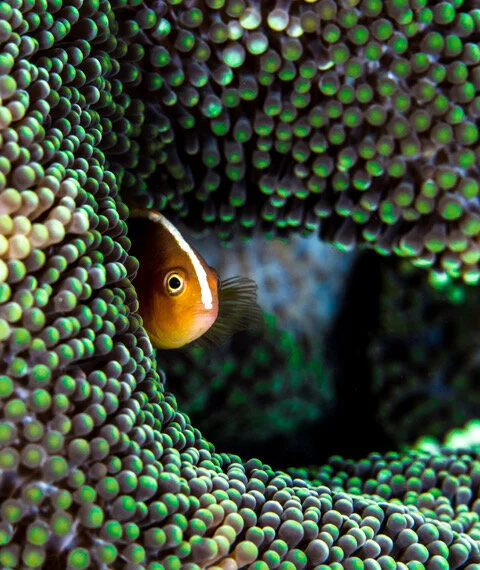
Little reef peek-a-boo. Eye stripes like the one this fella has may be an adaptation to break up the outline of the eye and confuse predators, especially in fish with false eye spots.
What are your hopes for the future?
In order to offset the disruptions we continuously cause, at the very least we owe it to aquatic animals to do our part to a) understand how we impact their ecosystems and b) consider ways to mitigate the effects of our impacts on them.
“Aquatic animals” as a whole is an immensely diverse group of organisms, and the individual support that different members of this group need may vary widely. Reducing our collective carbon and plastic footprints, choosing to eat sustainable foods, etc. are things we can do individually that benefit all animals, broadly.
In many ways, 2020 is a downbeat time to work in marine biology or conservation. We are flooded with constant messages about the declining state of affairs of the natural world, and we are often reminded that it is our species that is to blame.
My first hope for the future is that we’ll achieve a sufficient majority of those who believe that reversing the damage we are causing is worth pursuing, followed by a generation that is able to enact the advances in technology and innovation necessary to start to achieve sustainable objectives.
My second hope for the future is that many species will adapt to irreversible human-induced inputs in ways that we don’t expect or yet understand. Many models can predict the outcomes of shifting conditions based on what we now know, and such models often offer bleak predictions. I hope that some species will adapt in unpredictable ways that help preserve biodiversity.
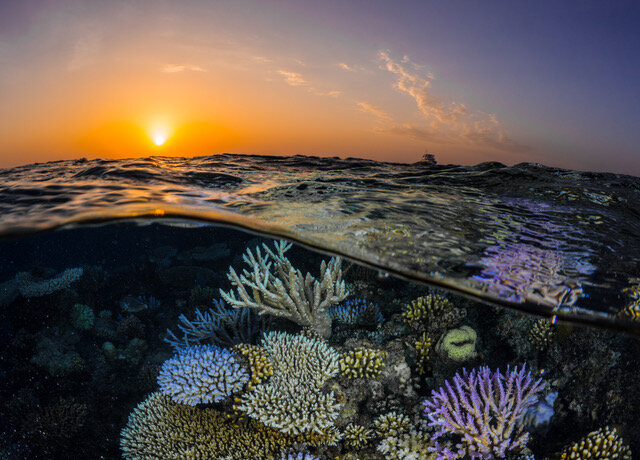
Sunset glow over a beautifully diverse reef in the central Red Sea.
How would you explain the intelligence and sentience of fish?
Intelligence and sentience in fish has been an often-ignored, and more recently, intensely debated topic.
As humans, we don’t connect on an emotional level to fish in the same way that we might to a dog, or cat, or some other mammal, so it’s easy to assume that fish don’t feel pain or react to stimuli in ways that we understand.
In the research community, many marine biologists (myself included) grew up fishing for sport, a pastime that can foster a love for the ocean and a desire to protect it. At the same time, avid fishers may have a hard time reconciling fishing for sport if they consider fish species to be intelligent or sentient. Generally, as I understand the literature, fish do “feel” or process pain and are more sentient than previously thought—and there are a number of studies that demonstrate this in different ways.
This is outside of my area of experience, but the scientific community (and even a growing number of commercial fisheries) generally recognizes this and takes steps to address it in their work. On a personal level, I can say that some species of fish seem much more charismatic and “sentient” than others. For example, I’ve never watched a goldfish and thought “I wonder what is going on in that mind!”.
But other species, like triggerfish, seem highly intelligent and quickly learn new skills or helpful behaviors—some individuals may even use tools to eat or even briefly leave the water to chase after intertidal prey.
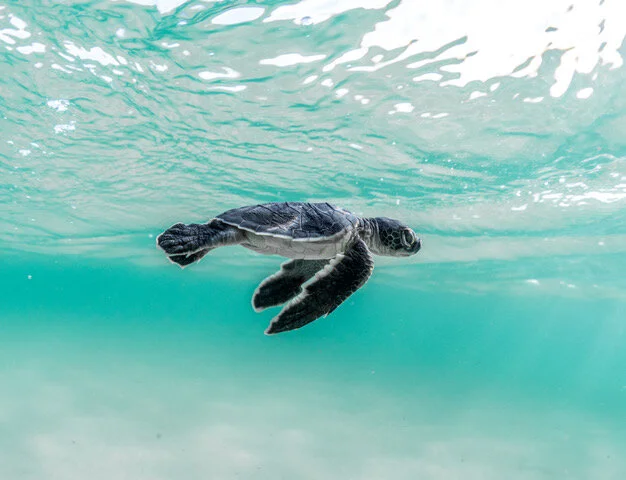
This 3-inch green turtle hatchling is ready for the weekend
(Thursday night in the Middle East)!